Two quotes for "the same" 3.5 g pouch can differ by a factor of three. The difference is never one big line — it is seven small ones, and all of them are visible if you know where to look.
Quotes for custom pouches come back in different shapes: some per thousand, some per pouch, some with a tooling charge hidden in a separate line. Comparing them is only possible if you know what moves the number. Here are the seven levers, roughly in order of impact.
1. Size, and the film that goes into it
Pouches are priced on material area. A 28 g pouch uses roughly two and a half times the film of a 3.5 g pouch, so at the same quantity it costs close to two and a half times as much. Size is the first lever and usually the biggest.
Gusset depth, film thickness and whether the pouch is die-cut all add material or processing. A die-cut outline means a cutting die, which is a one-off cost.
2. Barrier level
Metallised film is the workhorse and the value option. Aluminium foil costs more per square metre and behaves differently on the machine, so a foil pouch costs noticeably more than a metallised one at any quantity. Buy the barrier your product and shelf life need — no more. Most brands over-specify here.
3. Finish and special effects
Matte, glossy, holographic and soft touch are standard and priced into the base film. Foil, rose-gold foil and spot UV add a print pass or a stamping step and are quoted separately. On a small run, one special effect can add more to the unit price than the difference between 500 and 1,000 pieces — which is why it is worth costing both before deciding.
4. Closure
A standard zip lock and a child-resistant zipper are different closures, and the CR zipper costs more — it is engineered and applied as part of the pouch. No zipper is cheaper still, but it removes the reseal after opening, which most products want.
5. Printing method — the biggest single swing
| Method | Economics | Best for |
|---|
| Digital print | No cylinder cost, higher cost per pouch | Runs from 500 pieces, artwork changes, test markets |
| Gravure print | Cylinder cost per colour, much lower cost per pouch | Runs from 10,000 pieces, stable artwork, long-term lines |
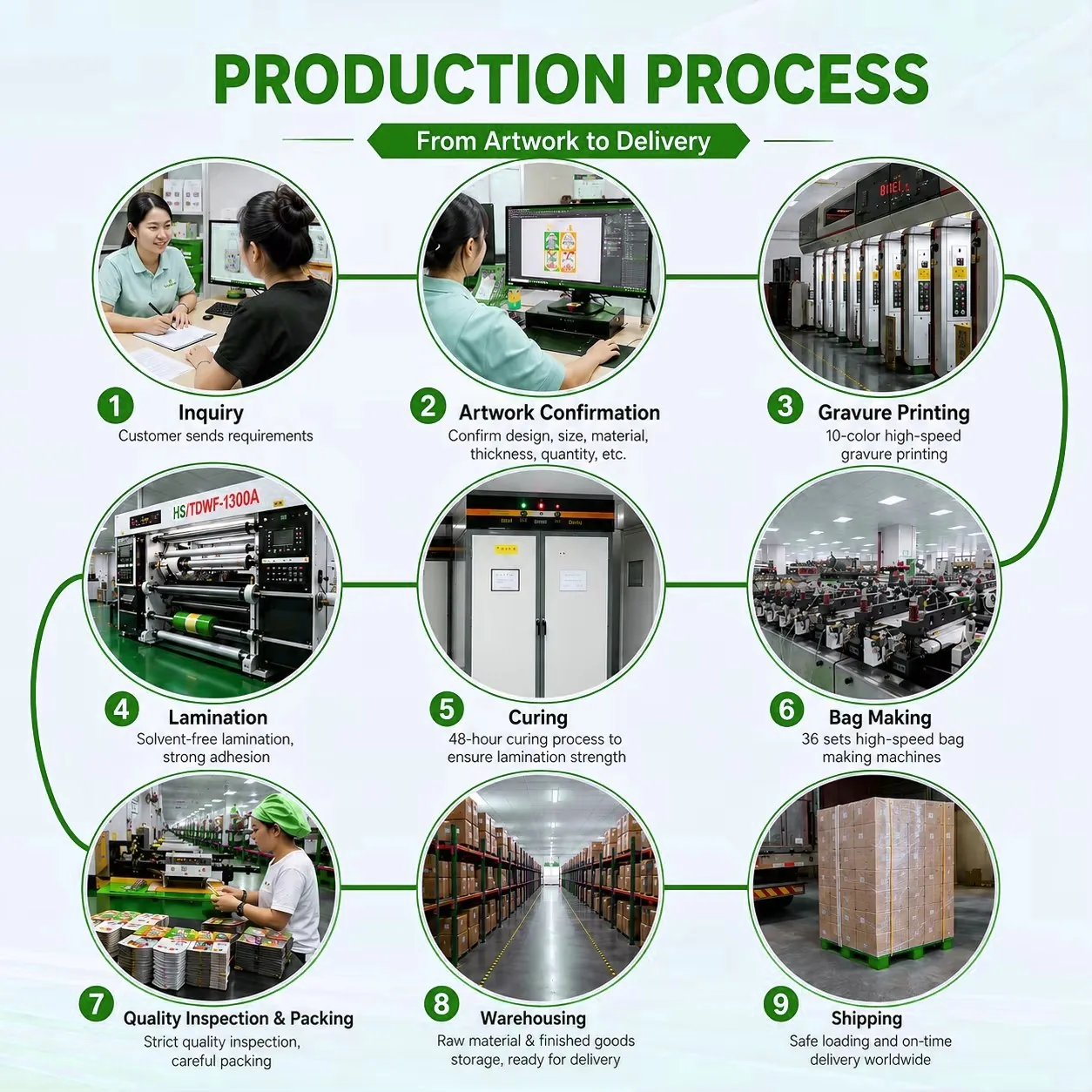
Gravure is how pouches are printed at scale: each colour needs an engraved cylinder, which is a one-off cost, and the price per pouch then drops sharply with volume. Digital printing skips the cylinders entirely, so it wins on small runs and loses on large ones.
Both are full colour, front and back, and both can match brand colours. The choice is arithmetic: at your quantity, is the cylinder cost spread over more pouches than the digital premium?
6. Quantity
Almost every cost above is divided by the number of pouches. Setup, cylinders, plates, machine time and quality checks do not scale linearly, so the unit price falls as the run grows. As an example on this site: a 3.5 g matte stand-up pouch with a standard zipper is US$0.60 per bag at 500 pieces, US$0.33 at 1,000 and US$0.16 at 3,000.
That curve is why 500-piece runs are for testing a market and 3,000-piece runs are for building a brand. Ordering too little to save cash and then reordering twice in a quarter usually costs more than ordering properly once.
7. What sits outside the unit price
- Sampling — sample fees, and the time they take. Cheap compared with a reprint.
- Freight and duties — air freight is fast and expensive per kilo; sea freight is the reverse. Whether your quote is DDP or DAP changes what you pay on arrival.
- Inner packaging — trays, inserts or a second pouch inside the outer one.
- Rework — any change after artwork approval that requires new cylinders.
Ask for the quote as a total landed number, not just a unit price. A pouch that looks 20% cheaper can lose that advantage at the port.
Where a small brand should spend and save
- Save: standard sizes instead of custom dimensions, metallised instead of foil unless the product needs it, one finish instead of foil plus spot UV, and stock-ready bags for the very first batch.
- Spend: the closure, if your market requires child resistance; a sample before the bulk run; and enough quantity to get past the steep part of the price curve.
Ready-made stock bags start at 200 pieces and ship within 3 days of payment — a legitimate way to test a market while a custom run is being printed.
What we need to quote accurately
Send: pouch size (or product and fill weight), quantity, closure, finish, whether the artwork is supplied or needs design, and the delivery country. We reply with unit price, total, tooling if any, and the dieline — usually within 24 hours, and with the print method that makes sense at your volume rather than the one that is easiest to quote.
If the number is higher than you expected, ask which of the seven levers is doing the damage. It is usually size or print method, and both are fixable before you commit. For the artwork side of the same project, see the artwork and dieline checklist.
Sources and standards
Primary sources for the rules and test methods referred to in this guide:
 Sainsun Mylar Bags