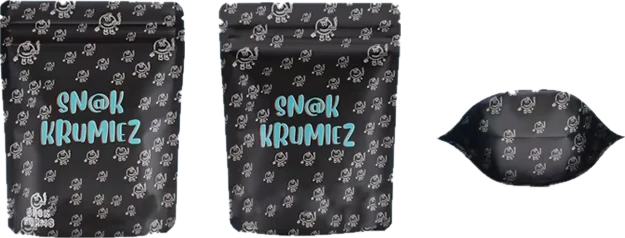
A heat-sealed mylar pouch is not a moisture barrier, it is a slow leak: the film, the seams and the zipper together lose water vapour at a rate you can specify and measure, and that rate is what decides the month-six taste. For most dry foods the usable figure is a WVTR under 0.5 g/m2/day, and a pouch that seals well but closes with a zipper rather than a full heat seal rarely gets there. This guide covers where the vapour actually escapes, how to read a WVTR figure before you order, and the 30-day weigh test that measures the real number for your own pouch.
A brand fills and heat-seals a run of one-pound flower pouches. The seal is good, the film looks right, the packs feel airtight. Eight weeks later the first complaint comes back: harsh smoke, hay smell, and — once somebody weighs a returned pack — measurably lighter than it left. Nothing is visibly wrong with the pouch. Water vapour has been leaving through the film and the seams the whole time, a fraction of a gram a day, and the pouch never once looked loose.
The same story shows up wherever a sealed pouch holds something with a moisture target: cured flower, freeze-dried fruit, jerky, milk powder. The complaint that flower over-dries in plain mylar is a recurring one in grower forums, and one pouch brand's in-house 90-day comparison put weight loss in sealed plain-mylar packs at around 4%, against well under 1% for a pouch with built-in humidity control. That figure is vendor data, not a peer-reviewed study — treat it as a direction, not a benchmark. But the direction matches the physics, and the physics is something you can check before you order.
"Smell-proof" and "moisture-proof" are two different specifications
Aroma molecules and water molecules are not the same size and do not travel the same way, so a laminate can be strong on one and mediocre on the other. Barrier performance is not a single number — it is at least three: oxygen transmission (OTR), water vapour transmission (WVTR) and light blockage. Marketing copy collapses all three into phrases like "smell proof" and "keeps freshness locked in", which is why two pouches described in identical language can behave completely differently on a shelf.
The number that governs drying-out is WVTR — grams of water vapour passing through one square metre of material in 24 hours. Lower is better. It is a property of the film stack, not of the bag's appearance, and it is the one figure a moisture-sensitive buyer should ask for by name. How the individual layers are built is covered elsewhere on this blog; here we stay on the number itself.
Ask for WVTR — with the test conditions attached
Published converter specifications give a useful sense of the scale. Foil-bearing laminates (PET / aluminium foil / PE) are typically quoted at or below roughly 0.1 g/m²/day, with some suppliers specifying below 0.05. Metallised PET structures (PET / VMPET / PE) commonly land between roughly 0.1 and 1.5 g/m²/day depending on coating quality and gauge. Plain clear laminates run several g/m²/day or worse. The gap between a foil structure and a mid-range metallised one is therefore about ten-fold — which is precisely the gap between "barely moves moisture" and "measurably dries product out over a season".
Two cautions before you put the number in a purchase order. First, the standard referee method is ASTM F1249, whose demonstrated measurement range runs from about 0.05 to 26 g/m²/day — a properly run report on a foil laminate should resolve it. Second, WVTR is measured at stated conditions, most commonly 38 °C and 90% relative humidity. Your warehouse is neither. Two suppliers quoting "WVTR" measured at different conditions are not quoting the same property. Insist that the quotation states the structure, the foil or coating gauge, the method and the conditions — and treat any vendor who cannot produce a report, only an adjective, as unverified. The same discipline applies to the other numbers on the quote: the supplier vetting checklist covers how to tell a mill from a trader.
Do the arithmetic before you choose between foil and metallised
Moisture movement through the film follows a simple relation: grams lost ≈ WVTR × pouch area × time. The area is bigger than most buyers assume, because a gusseted pouch has six-ish faces, not two:
| Pouch format (typical) | Approx. film area | g/day at WVTR 1.0 (test conditions) |
|---|
| 3.5 g pouch, ~90 × 130 mm + 25 mm gusset | ~0.03 m² | 0.03 g |
| 28 g pouch, ~130 × 200 mm + 40 mm gusset | ~0.07 m² | 0.07 g |
| 1 lb pouch, ~250 × 350 mm + 50 mm gusset | ~0.21 m² | 0.21 g |
| 5 lb pouch, ~300 × 450 mm + 60 mm gusset | ~0.32 m² | 0.32 g |
Those are test-condition figures. In a real warehouse the vapour-pressure difference across the film is far smaller than the 38 °C / 90% RH test gradient: saturating vapour pressure is about 2.34 kPa at 20 °C, so a pack equilibrated around 60% internal RH sitting in a 20–50% RH room is running at roughly one-sixth of the test driving force. Apply that rough derating to the one-pound pouch: a metallised structure at WVTR 1.0 moves on the order of one gram of water per month; a foil structure at 0.1 moves about a tenth of that. A 454 g pack of flower carries roughly 45 g of water, so the metallised path is on the order of 2% of the pack's moisture per month. The first-month estimate runs high because the gradient decays as the product dries toward equilibrium — which is why the field observations of a few percent over 90 days sit just below it. The arithmetic and the field reports agree on what matters: the structure choice alone is the difference between a pack that holds its moisture for a season and one that quietly sheds it.
Why the grams are worth chasing: in cannabis trade discussion, over-dried flower is commonly put at around 5% less weight than well-cured flower — a straight revenue haircut on every unit sold, and no two-way humidity pack can restore the terpenes that left with the water. The pouch decision is cheaper than the shrinkage.
Where the grams actually escape: seams, zippers and creases
The film is only one path. In practice, when measured moisture loss comes out far above the film estimate, the excess is almost always escaping through the closure or through damaged barrier, not through intact laminate:
- The heat seal. A continuous, full-width seal is the only genuine barrier closure a pouch has. Contamination in the seal zone, wrinkles crossing the seal, or a seal pinched thin at a corner all create channels — the same defects that show up in leak testing, which the pinhole and seal testing checklist covers bench by bench.
- The zipper. A press-to-close or slider zipper is a mechanical closure, not a laminate. Every open-close cycle wears it, and powder or resin dust on the track stops it from closing fully. A resealable pouch is a different moisture barrier after its first opening than before it — the closures comparison breaks down reseal life and where each closure type belongs.
- Creases and folds. Aluminium foil tolerates bending poorly; hard creases at gussets and fold lines can crack the barrier layer while the outer film looks untouched. Metallised coatings flex-crack less severely but start with more microscopic defects to begin with.
This is also why two batches of the "same" pouch can perform differently: the film may be identical while the seal window drifted, or the gusset geometry changed. If your measured loss rate jumps, suspect the process before the material.
The 30-day weigh test: measure your actual pouch, not the brochure
You do not need a laboratory to get the real number for your pack. Total weight loss of a sealed pouch is a direct measure of moisture leaving it, and a 0.01 g kitchen or jewellery scale resolves it:
- Fill three to five pouches with your actual product at your production fill weight, and heat-seal them at your normal settings — not with a hand sealer on a desk, or you are measuring a different process.
- Weigh each sealed pouch to 0.01 g and record the date, the pouch area, and the room temperature and humidity.
- Store them at a fixed, representative room condition — not on a windowsill, not above a radiator.
- Re-weigh at 7, 14 and 30 days. Compute grams lost per day, then divide by the pouch area to get g/m²/day.
- Repeat with a second set closed by zipper only, if your retail format is resealable. The difference between the two sets is what the closure is costing you.
Compare the film-only figure against the supplier's quoted WVTR. If your measured rate is several times the quoted one, the leak is in the seams or the zipper, and the fix is a process conversation, not a film upgrade. If it matches, the film choice is the lever. Either way you now have a number from your own product instead of an adjective from a catalogue.
What to write into the order
- A WVTR limit, with method and conditions — for example "≤0.1 g/m²/day, ASTM F1249, 38 °C / 90% RH", not "high barrier".
- The structure by gauge, including foil or coating thickness, so the barrier cannot be silently downgraded between sample and production.
- Seal width and tolerance, so the barrier you paid for survives the sealing step.
- Zipper specification and expected reseal life if the format is resealable — and an honest internal decision about how many openings the format is meant to survive.
- A moisture plan for the product inside. The pouch holds the condition you put in; it does not create one. Flower entering the pack off-target will come back off-target, just protected.
- Production samples filled and sealed as in real production, run through the 30-day weigh test before the volume order — the cost of the test is a scale and a month; the cost of skipping it is a season of shrinkage. Matching pouch size to fill weight matters here too, because a half-empty pouch pays for barrier area it does not use.
A mylar pouch is a very good moisture barrier and a finite one. Decide how many months your product must survive, put a number on the film, test the seams you control, and weigh a pack before your customer does.
Sources and standards
References for the test methods and figures used in this guide:
 Sainsun Mylar Bags