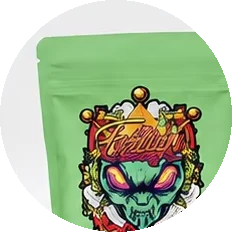
Between October and December, a mylar bag stops being just a barrier and becomes the gift. Candy tins get replaced by printed stand-up pouches, collectible drops ship in foil-finish packs, and coffee or tea gift sets hide a resealable bag inside a box. The print and closure decisions decide whether it reads premium — and the lead-time math decides whether it arrives at all.
A gift changes what the package is for. The rest of the year, a mylar pouch is judged by what it keeps out: oxygen, moisture, light, smell. In the gifting window it is judged by what it puts out — colour, finish, the weight of the foil when it is picked up — while still having to do the barrier job. That dual role changes several decisions at once: the print finish, the closure, the size, and how early the order has to be placed. This guide walks through each, and finishes with the courier arithmetic that decides whether a Q4 order is still alive.
The finish is the gift: matte, gloss and metallic accents
Under gift-shelf lighting, the difference between two identical structures is almost entirely the finish. The three workhorse options:
| Finish | What it does | Suits |
|---|
| Matte (soft-touch feel) | Mutes colour, hides fingerprints, reads premium in the hand | Tea, coffee, skincare-adjacent gifts, anything "artisan" |
| Gloss | Maximises colour punch and shelf visibility | Candy, snacks, kids' gifting, bright illustration-led designs |
| Metallic film / spot accents | Printed areas shine through a foil layer; spot UV raises selected art | Limited editions, collectibles, gold-and-black seasonal schemes |
Metallic effects deserve one technical note. There are two ways to get shine: print onto a metallised film (shine appears wherever ink does not cover, in the film's own silver or gold), or use spot finishes that apply gloss or texture only to chosen areas of the artwork. The first is cheaper and very effective for full-foil seasonal designs; the second is the one that makes a logo or a snowflake catch the light against a matte background. Both need artwork prepared with the finish boundaries drawn explicitly — the artwork and dieline guide explains what files a printer actually needs, and this is the one step worth doing before the holiday clock starts.
One honesty note from the factory side: spot finishes are applied in print, not glued on later, so the decision belongs in the artwork file and the quote — deciding to "add some gold" after printing is not a thing. Choose the finish with the artwork, not after it.
Closures: a gift gets opened once, a refill gets opened weekly
Gifting changes the closure logic. A present is opened with ceremony and rarely resealed — heat seal with a tear notch is honest, cheap and looks clean under a box sleeve. A refill pack — the second bag someone buys after loving the gift — is opened weekly for months and needs a zipper; the closure comparison guide breaks down the options and their costs. The mistake to avoid is paying for a child-resistant or slider closure on a pack whose life is one unboxing.
The seasonal exception: anything edible aimed at households with children — candy above all — may need child-resistant hardware depending on what is inside and where it is sold. Child resistance is a property of the finished pack, tested in the market where it is sold, not a sticker the factory applies; what "certified" actually means covers that in detail. If your gift product is a supplement or anything with dose-based potency, raise CR at the enquiry stage, because it changes both the closure and the test plan.
Sizes for candy, collectibles and coffee
Gift sets fail on size more often than on print. Three patterns cover most seasonal briefs:
- Single-serve candy or truffle packs: small flat pouches in the 3.5–28 g range, often heat-seal only, printed edge to edge. The fill-weight sizing guide maps product weight to pouch dimensions.
- Collectible drops — trading cards, pins, small toys: a stiff pouch sized to the card plus a little slack, with a matte or metallic finish. The barrier spec matters less than the crease-free presentation; a soft laminate that lets the contents slump reads cheap.
- Gift-set inner bags: a resealable pouch that lives inside a rigid box — coffee, tea, dried fruit. The box does the gifting; the pouch does the freshness work, so this is where the barrier spec (film structure) still matters most.
The sizing rule for gifts differs from daily use: leave less headroom than you would for a shelf pack. A half-empty gift pouch reads as stingy in a way a functional pack never does. Size to the filled state and proof it with a physical sample before bulk.
The Q4 clock: why courier changes the deadline
Here is the part that decides whether this article's advice reaches your shelf this year or next. Flexible-packaging lead times are usually quoted around sea freight, and on that basis the standard advice — order three months out — is correct. But a mylar order is short-run by nature, and short runs travel as parcels, not containers. That changes the arithmetic.
Our production figures: about 3–10 days after artwork approval, with dispatch around 5 days on the standard route. An express courier leg typically runs 3–7 days door-to-door depending on destination — confirmed per shipment. Add a buffer for the holiday season and the cutoffs look like this:
| Season | On-shelf date | Order by (express courier, 10-day production) |
|---|
| Halloween | 31 October | ~9 October — closed for this year unless artwork is approved immediately |
| Black Friday | 27 November | ~5 November |
| Christmas | 1 December | ~9 November |
| Christmas | 10 December | ~18 November |
The Halloween row deserves its honesty. The cutoff has passed for a comfortable order — but a mylar order is the one packaging category where "artwork approved this week, production starts tomorrow" is a real scenario rather than a sales line, because runs are short and the production window is measured in days, not weeks. A brand that approves final artwork within days of an order can still land a small Halloween run in late October by courier. It is tight, it needs the artwork ready today, and the written quote is what makes the date binding.
Everything else in the table is comfortably open. The single biggest lever is not the factory speed — it is artwork. A print-ready file (dieline matched to the actual pouch size, fonts outlined, finish boundaries drawn) starts the clock the day it lands; a file under revision starts nothing. The artwork guide is the checklist to hand your designer this week, not in November.
The one-line version
A gift mylar bag is two products in one: a finish decision (matte, gloss, metallic or spot) that decides how it reads on the shelf, and a barrier decision that decides how the contents taste when they are finally opened. Choose the finish with the artwork, size to the filled state, keep the closure honest to how the pack will actually be used — and start the artwork now, because artwork, not production, is what the Q4 calendar eats first.
Sources and standards
Primary references for the compliance and barrier topics touched on in this guide:
 Sainsun Mylar Bags